CivicTwin Spark (NVIDIA Hackathon)
The Vision
A digital twin that lets cities stress-test their 311 systems before real crises hit.
CivicTwin Spark is an agentic urban simulation sandbox that generates 10,000 synthetic citizens with realistic behavioral profiles — running them through a spatial-temporal digital twin of Toronto to forecast 311 demand, auto-triage complaints, and produce AI morning briefings for city operations teams.
The Challenge
Cities lack a way to stress-test their 311 service request systems against realistic urban friction and emergency situations.
The Process
Built an agentic urban friction and emergency simulation sandbox running 10,000 generative citizen agents through a spatial-temporal digital twin of Toronto using RAPIDS cuDF, cuML, and NVIDIA NIM.
The Impact
Created a closed-loop simulation on the NVIDIA DGX Spark that forecasts 311 demand, triages complaints via embeddings, and generates AI morning briefings locally.
Platform Gallery
Click to explore the 311 Forecaster dashboard, AI briefings, and simulation engine.
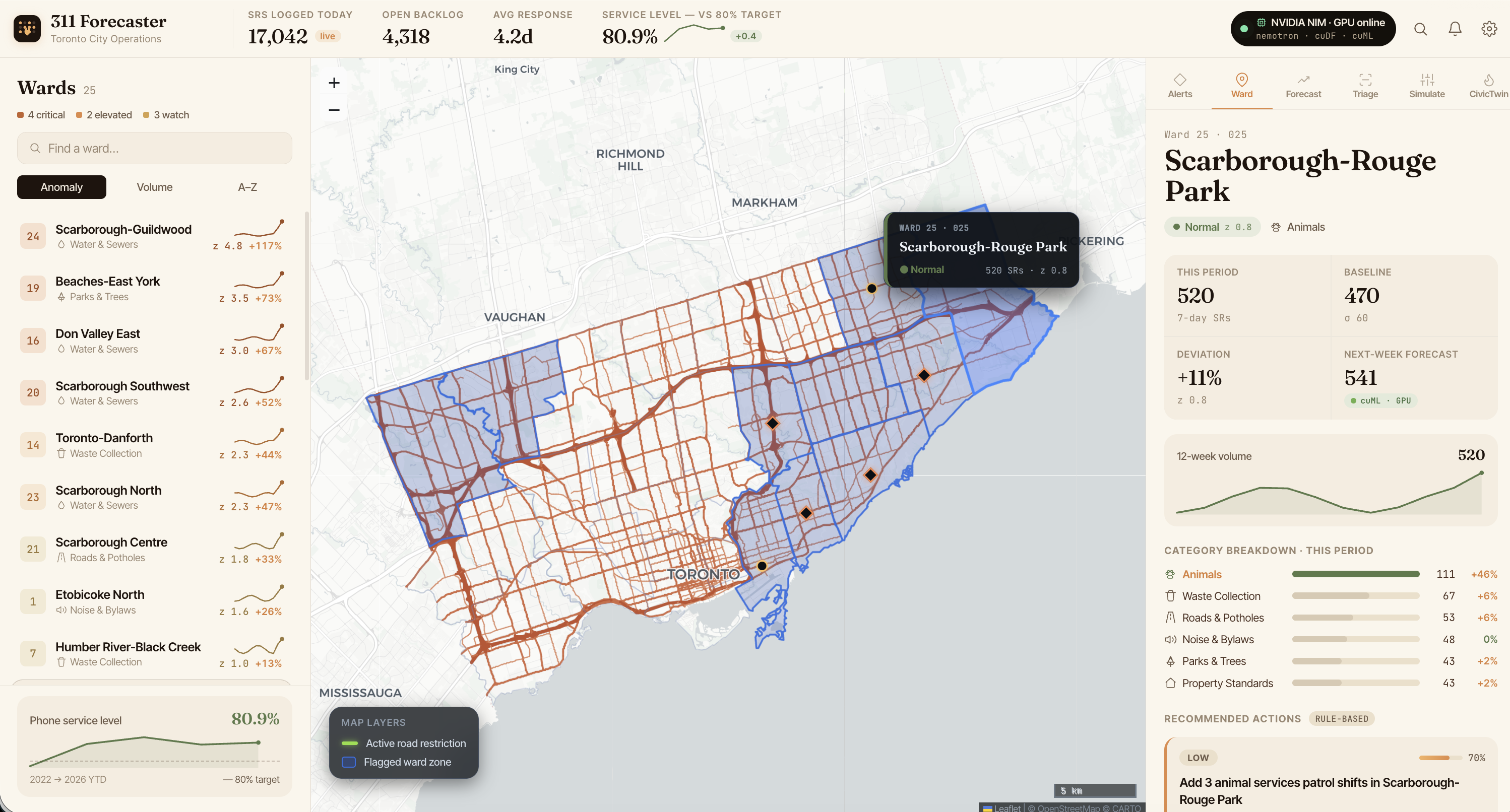
Spatial Intelligence at a Glance
The main 311 Forecaster dashboard showing Toronto's ward-level anomaly detection, real-time service metrics, and geographic hotspot visualization with active complaint trajectories.
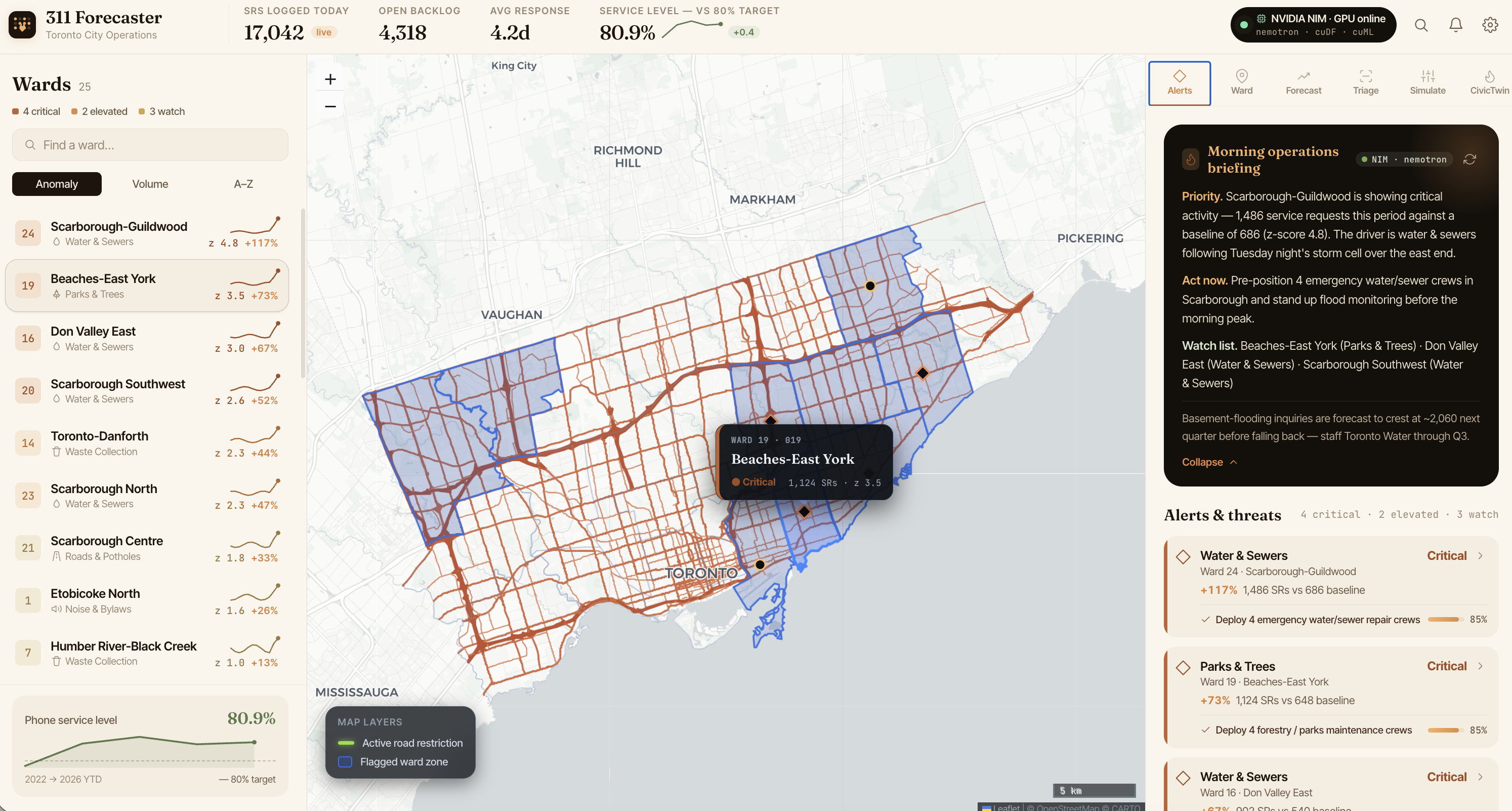
AI Morning Operations Briefing
An AI-generated daily operations briefing that surfaces critical activity, watch-list wards, alerts and threats — giving city operations managers an actionable summary before they start their day.
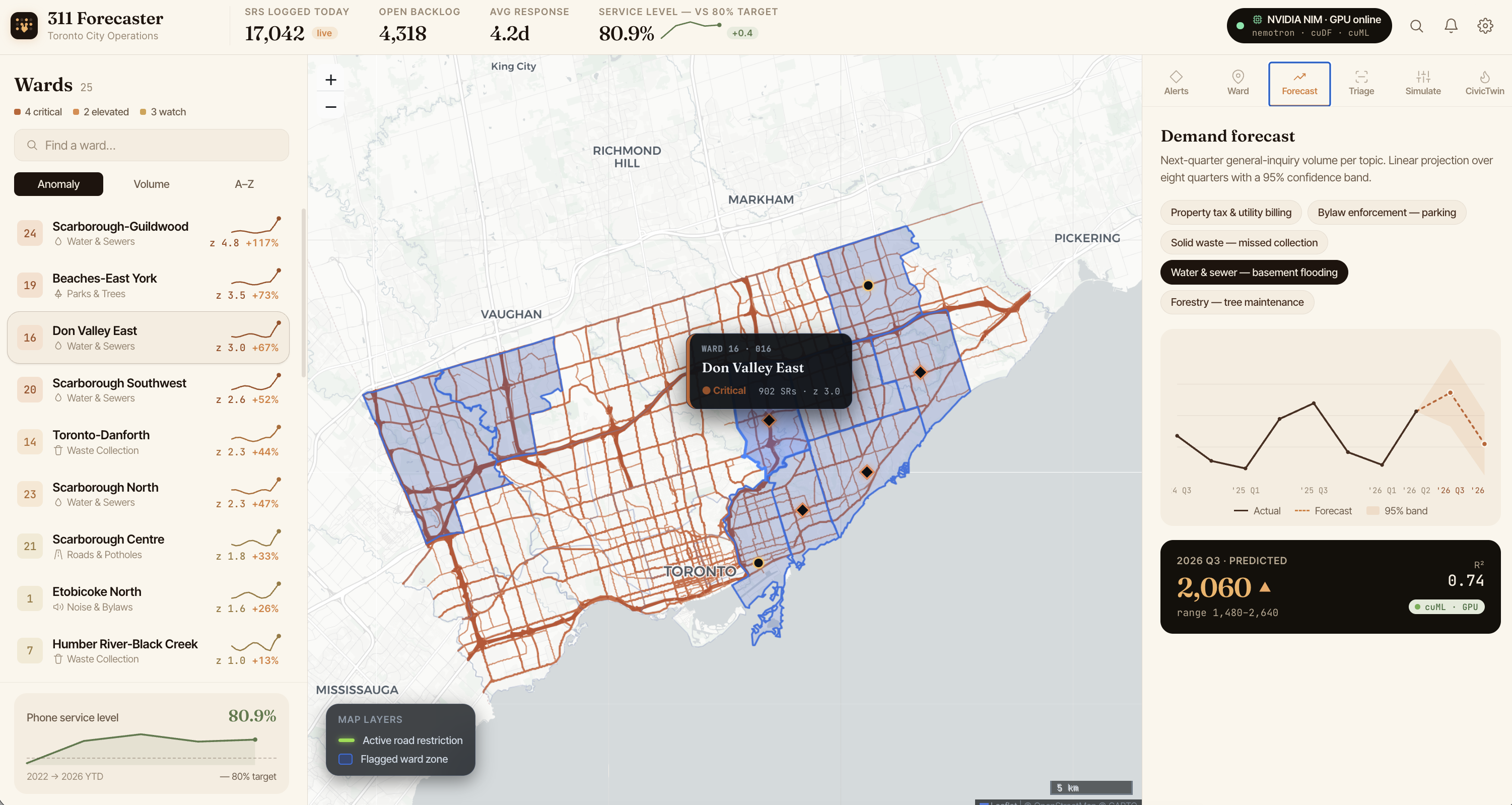
Predictive Demand Modeling
Next-quarter demand forecasting with linear projection and 95% confidence bands, broken down by service type — enabling proactive resource allocation before complaints spike.
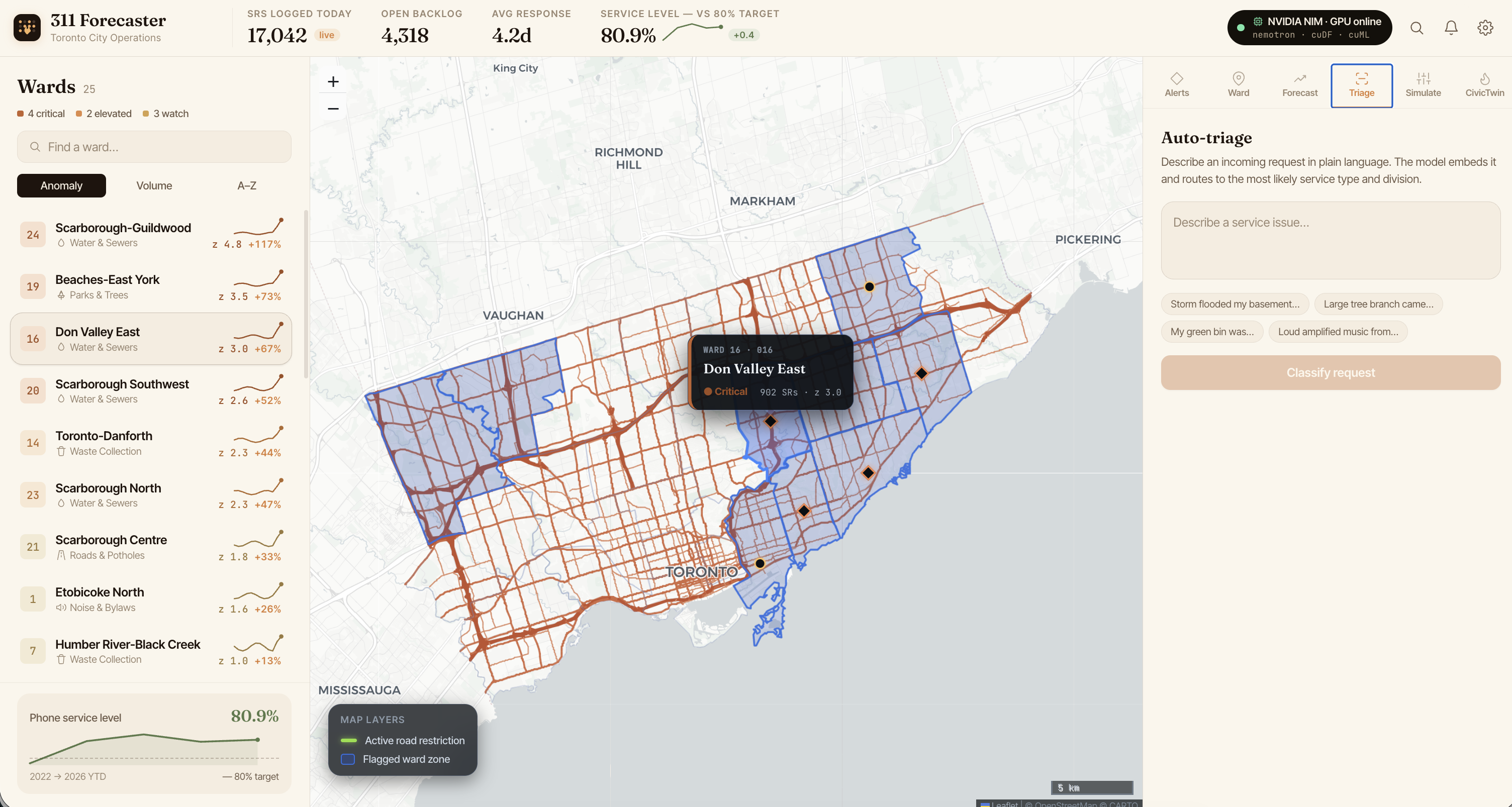
NIM-Powered Request Classification
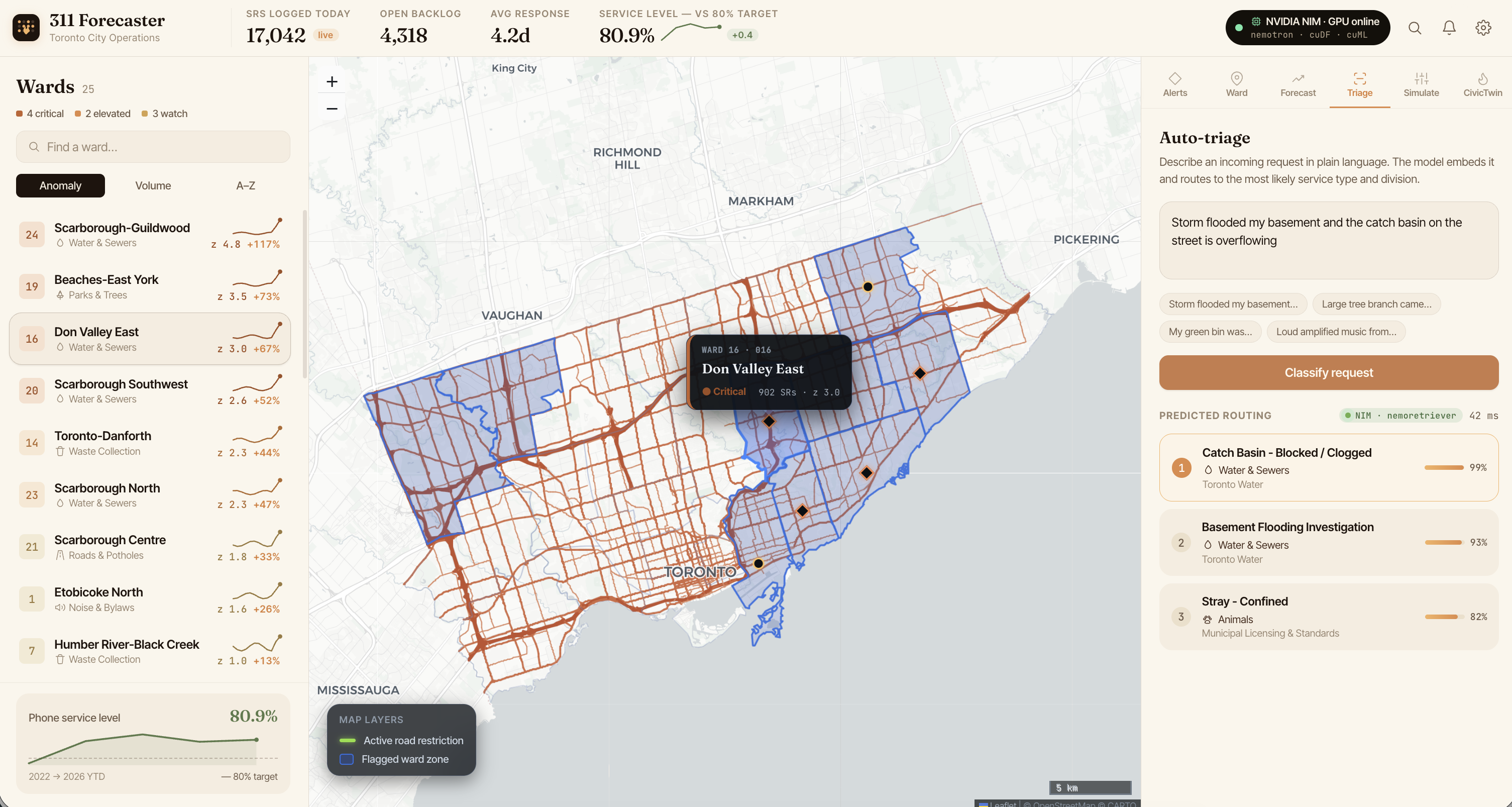
Natural language auto-triage powered by NVIDIA NIM. Citizens describe issues in plain text and the model classifies them to the most likely service type and division in real-time.
Embedding-Based Routing
The classification results showing confidence-ranked service matches — Catch Basin, Basement Flooding Investigation, and Stray Animal — derived from semantic similarity against historical 311 data.
What-If Resource Modeling
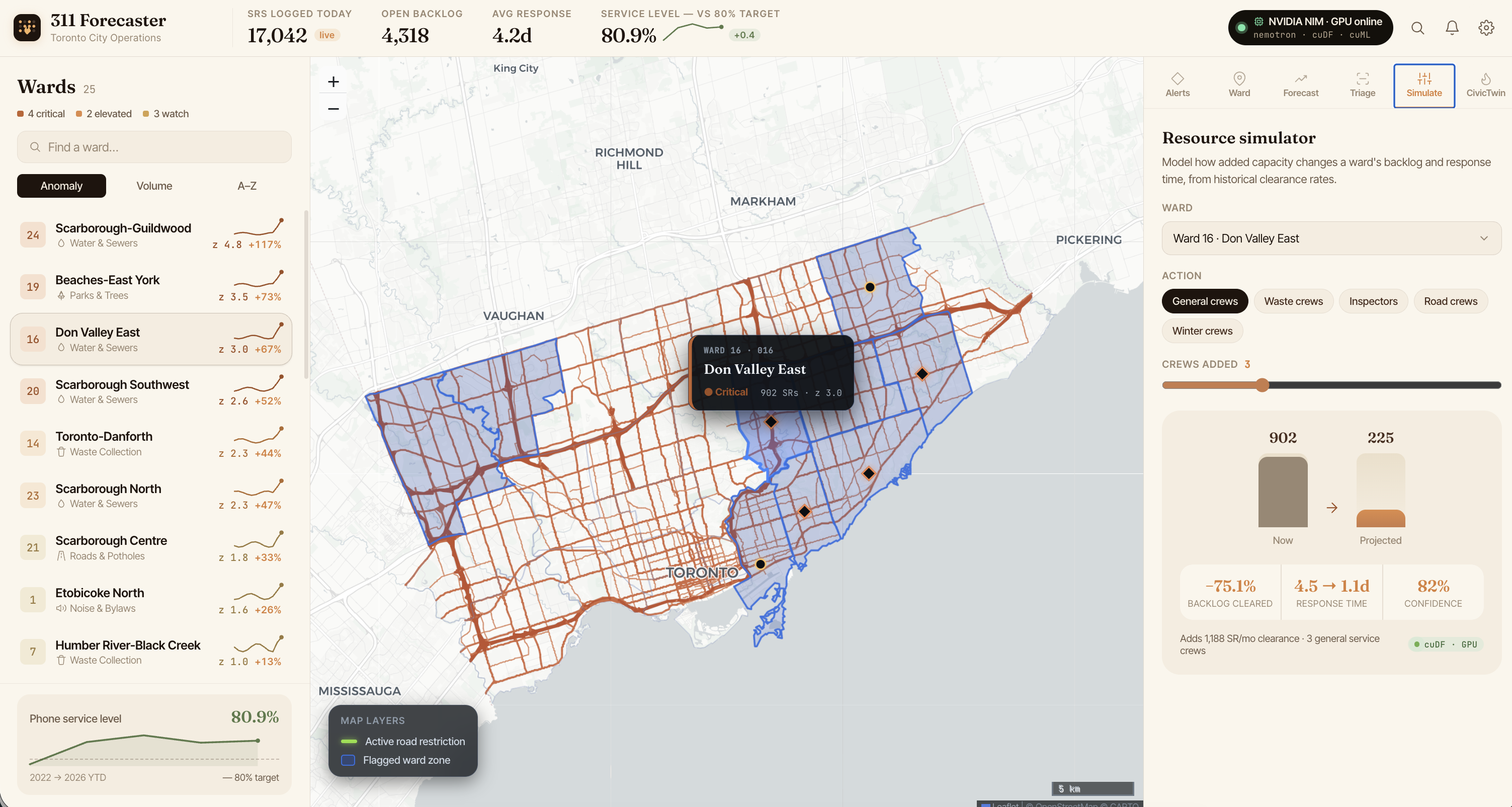
An interactive resource simulator that models how added crew capacity changes a ward's backlog clearance and response times, letting planners test staffing scenarios before committing budget.
Live Agent Simulation
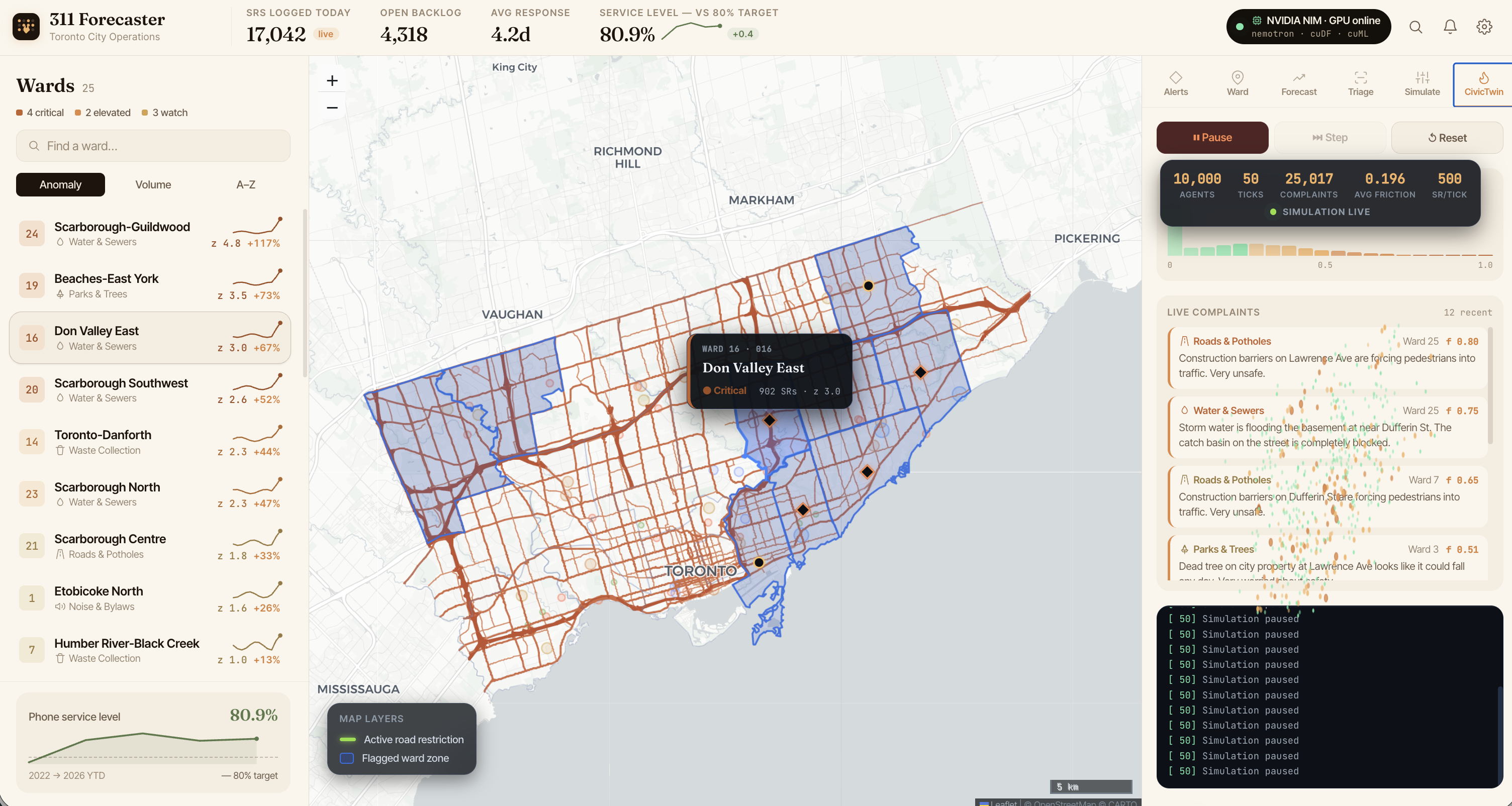
The generative agent simulation engine running 10,000 synthetic citizens through the digital twin — producing realistic 311 complaint patterns with full spatial-temporal fidelity on NVIDIA DGX Spark.
Architecture
Simulation Layer
10,000 generative citizen agents with behavioral profiles, daily routines, and frustration thresholds running through a spatial-temporal digital twin of Toronto.
GPU-Accelerated Pipeline
RAPIDS cuDF and cuML for real-time anomaly detection, demand forecasting, and clustering — all running locally on the NVIDIA DGX Spark.
Spatial Intelligence
Ward-level geographic visualization with active complaint trajectories, hotspot detection, and zone-based anomaly scoring across 25 wards.
NIM Auto-Triage
NVIDIA NIM embedding models classify free-text citizen complaints into service categories with confidence-ranked routing against historical 311 data.
Demand Forecasting
Linear projection models with 95% confidence bands predict next-quarter complaint volumes by service type for proactive resource allocation.
Resource Simulator
What-if modeling engine that tests staffing scenarios — showing how added crew capacity affects backlog clearance, response times, and coverage.
Tech Stack
Simulation Metrics
Synthetic Citizens
10,000 generative agents with unique behavioral profiles and daily routines.
Service Coverage
17,042 active 311 requests tracked across Toronto's 25 municipal wards.
Response Target
80.9% service level maintained with 4.2-day average response time across all categories.
GPU Inference
All anomaly detection, forecasting, and NIM triage running locally on a single DGX Spark.